
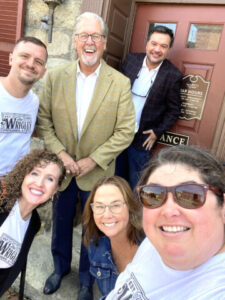
 Corbin Mayor Suzie Razmus, Corbin Economic Development Executive Director Bruce Carpenter, Corbin Downtown Coordinator Jacob Roan and Kristin Smith, John Medlock and Kendall Bryant, all of the Wrigley Taproom and Eatery, recently joined Kentucky Senate President Robert Stivers, Senator Jimmy Higdon, and several other special guests at a special Elijah Craig barrel selection event at Heaven Hill in Bardstown.
The event, held on Tuesday, Sept. 16, was a celebration of Kentucky’s farm-to-table culture, culinary tourism, and the growing storytelling opportunities being made possible through recent legislative efforts in Frankfort, including Senate Bill 1 (SB 1), which created the Kentucky Film Office within the Cabinet for Economic Development. The office is designed to market the state as a premier filming destination, streamline the permitting process, and support productions through the Kentucky Entertainment Incentive Program. Currently, Kentucky has $75 million in available incentives annually, and production companies may also be eligible for additional incentives to hire a local workforce.
Kentucky’s reputation as the birthplace of bourbon set the stage for a broader story about unity, culture, and the future of film and tourism. Leaders from across the Commonwealth gathered at Heaven Hill for the special Elijah Craig barrel selection, bringing together voices from Louisville and Corbin in celebration of Kentucky’s shared identity.
Last week’s event paired Hotel Distil co-owner Steve Poe of Louisville with the Wrigley owner Kristin Smith, who together selected a single barrel to be bottled under a custom label. Joined by Stivers, Razmus, Louisville Mayor Craig Greenberg, and other industry leaders, the event demonstrated how Kentucky’s urban and rural communities are united by more than geography inside the state lines, but are bound by history, food, culture, hospitality, and the storytelling opportunities all things Kentucky bring to the table.
Kentucky’s tourism industry is already delivering record results. According to the economic impact of visitors to Kentucky in 2024, the sector generated $14.3 billion in economic impact, supported more than 97,000 jobs, and welcomed 80 million visitors. It was the third consecutive year of record-breaking growth. Much of that spending was for food and drink as travelers invested $2.6 billion in Kentucky’s restaurants, farms, and distilleries. These numbers indicate how events like today’s are more than ceremonial. They reflect an economy where farm-to-table dining, hospitality, and cultural storytelling drive growth across both our largest cities and our most rural communities.
Razmus reflected on the pride her community feels in being part of an event that highlights both small-town heritage and statewide connection, saying, “This event is a wonderful opportunity to showcase two very distinct cities and the restaurants that anchor them, highlighting not what separates us but what connects us, our shared love of bourbon, food, and community. Communities like Corbin are not apart from Louisville, but tied to it. Together, we reflect the best of Kentucky’s culture and history, and together we share a story bigger than any one city. May today’s barrel selection capture with every sip the spirit of unity and the traditions that connect us.”
Greenberg echoed that sentiment, speaking from the perspective of Kentucky’s largest city and economic engine on the importance of collaboration across communities when he said, “As Kentuckians, we often say bourbon is in our blood. Nowhere is that more true than in Louisville, where the industry fuels jobs, tourism, and our city’s global reputation, but the story does not stop here. Louisville’s success is tied to the hard work, hospitality, and traditions of rural communities like Corbin and Bardstown, just as their success is connected to ours. Together we are stronger, and together we are building a Kentucky that honors its history while creating an even brighter future.”
Beyond government leaders, Kentucky’s chefs and restaurateurs are also central to this story.
The day’s focus on food and hospitality exemplifies how deeply culinary traditions shape the Kentucky experience. In Corbin, The Wrigley has built its reputation on sourcing the freshest local ingredients with a rotating menu of craft beer, cocktails, and more than 60 Kentucky bourbons. Featured in Time Magazine, Food & Wine, and Forbes, the Wrigley has become a destination for visitors who want an authentic taste of southeastern Kentucky.
“At the Wrigley, every dish tells the story of southeastern Kentucky farms and the people behind them,” Smith said. “Farm-to-table dining in Corbin draws on the same traditions that make bourbon country legendary—it’s about food and about connection. Kentucky’s culinary culture is driving tourism and showcasing the depth of rural places like Corbin, where our landscape is both beautiful and vital to the food and bourbon that defines our state.”
In Louisville, Hotel Distil stands as a modern landmark on historic Whiskey Row. Opened in 2019 as part of Marriott’s Autograph Collection, the hotel features 205 luxury rooms, more than 15,000 square feet of event space, and a celebrated restaurant, Repeal Oak Fired Steakhouse. The property brings together Louisville’s historic bourbon heritage with world-class hospitality.
This shared bourbon selection, carrying the Wrigley name and poured in both Louisville restaurants and Corbin, turns Kentucky’s urban–rural connection into something visitors can taste.
You Belong Here series bringing together chefs and filmmakers
Kentucky’s growing role as a home for authentic storytelling has drawn national attention. The You Belong Here series, co-created by Kentucky chefs and filmmakers, was featured at the Tribeca Film Festival, showcasing how communities like Corbin are telling stories that resonate far beyond the Bluegrass State.
This momentum connects directly to Kentucky’s legislative priorities, including SB 1, which established the Kentucky Film Office within the Cabinet for Economic Development. The office is designed to market the state as a premier filming destination, streamline the permitting process, and support productions through the Kentucky Entertainment Incentive Program.
Stivers framed the event as a showcase of Kentucky’s unique cultural assets, from natural beauty to food and hospitality.
“For those of us who call Kentucky home, the blessings of this state are no surprise. But for those visiting, even a small glimpse of our commonwealth is an exceptional experience,” Stivers said. “The opportunities before us are great, with growth rooted in our signature industries, our diverse landscapes, and our welcoming spirit. Kentucky has no shortage of stories to tell, and we are ready to share them with the world.”
Last week’s selection was about more than bourbon. It was about the story Kentucky is writing. With film, food, and culture at the forefront, the commonwealth is proving that its future lies in telling authentic stories that showcase both its urban energy and rural traditions.
“What begins in a barrel here in Bardstown will soon be poured for visitors in one of our most urban centers and in one of our most rural communities,” Stivers added. “That’s the spirit of Kentucky’s farm-to-table story. From field to kitchen, from still to glass, our work connects people across the commonwealth and gives them a taste of who we are.”